
What Is FDC? Florida Department of Corrections
FDC is the Florida Department of Corrections, the statewide prison and community-supervision agency. The agency's FY 2024-2025 Annual Report identifies it as "Florida Department of Corrections (FDC or Department)," and its homepage uses FDC in its statewide public description.
The official Florida Department of Corrections homepage is the public entry point for FDC's statewide prison, offender search, institution, and records resources.
The homepage screenshot supports the agency-abbreviation and statewide-system framing used throughout the FDC inmate population page.
FDC is not a county jail system. It is the system of record for sentenced Florida state prisoners, release records, escape records, supervised population records, and absconder/fugitive records. A person arrested today in a Florida county normally appears first in a county jail or county corrections database if booked and not released before intake.
The FDC Inmate Population
The FDC inmate population was 89,087 inmates present in the Florida prison system on June 30, 2025. FDC reported that this was an increase of 1,784 inmates, or 2.0%, from the previous fiscal year. The Florida Department of Corrections inmate population is separate from the February 2026 county detention estimate of 54,432 inmates, which counts people in county detention facilities rather than sentenced state prisoners.
| Measure | Figure | Source / Date |
|---|---|---|
| FDC inmate population in custody | 89,087 | FDC Annual Report FY 2024-2025, June 30, 2025 |
| Annual admissions | 27,171 | FDC Annual Report FY 2024-2025 |
| Annual prison releases | 25,990 | FDC Annual Report FY 2024-2025 |
| County detention population estimate | 54,432 | FDC county detention report, February 2026 |
The FDC inmate population also has a community-supervision side. The agency homepage states that FDC supervises more than 146,000 offenders in the community, and the Corrections Offender Network includes supervised population and absconder/fugitive searches. A person can therefore have an FDC record because of state prison custody, release status, supervision, or absconder status, even when no county jail roster entry is active.
How to Search the FDC Inmate Locator
The official FDC inmate locator for incarcerated state prisoners is the Inmate Population Information Search. The broader Corrections Offender Network menu also includes all-offender search, inmate release, inmate escape, supervised population, and absconder/fugitive searches.
The FDC Corrections Offender Network menu shows how the agency separates inmate population, release, escape, supervised population, and absconder/fugitive searches.
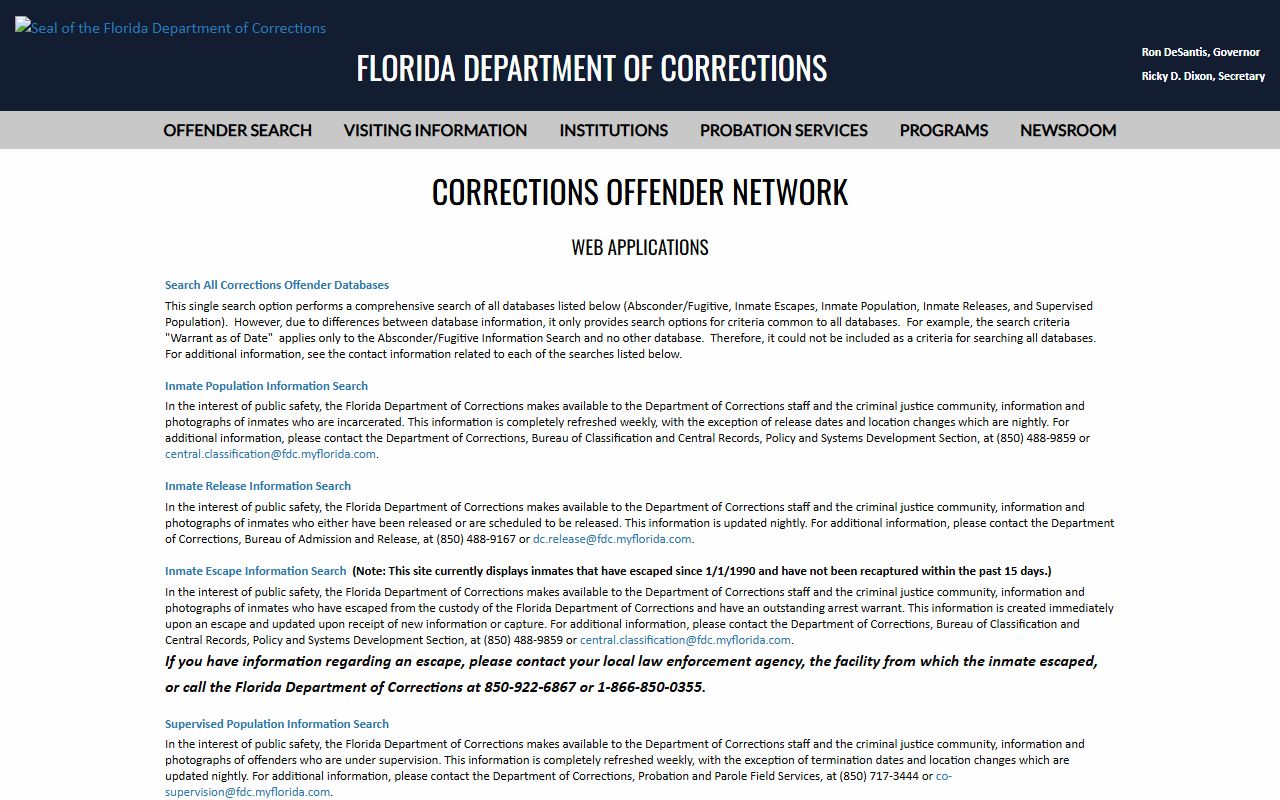
The menu screenshot helps explain why the correct FDC search can depend on whether the question is current prison custody, release, supervision, escape, or absconder status.
- Open the FDC Inmate Population Information Search or the Corrections Offender Network menu.
- Search by DC Number when known; otherwise use last name, first name, and the alias option if spelling is uncertain.
- Use photo display and match-limit options to narrow or review results.
- Open the matching profile and verify identifiers, location, offense, sentence, release, or supervision information.
- If FDC has no match, search the county jail, BOP, ICE, VINELink, and court records as appropriate.
The actual incarcerated-prisoner search form is the FDC Inmate Population Information Search.
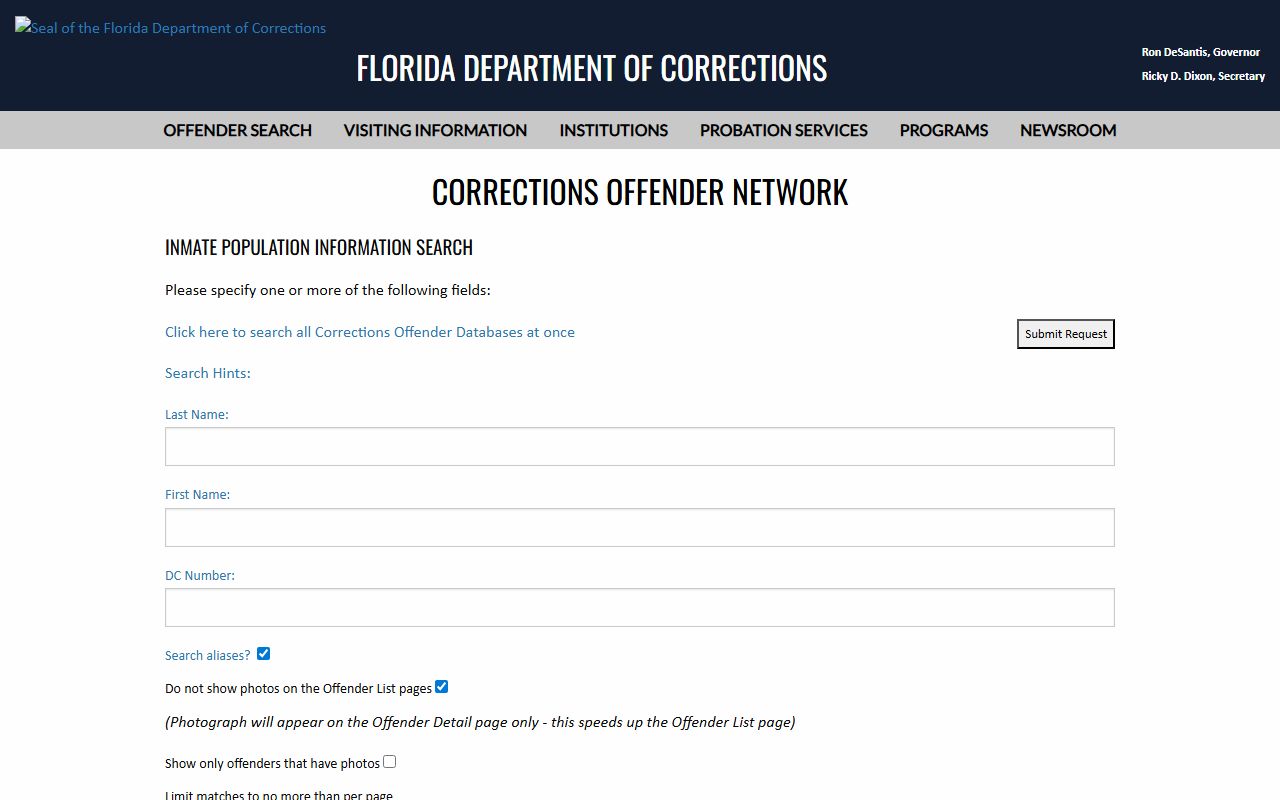
This screenshot ties the step-by-step search instructions to the fields users see when searching the FDC inmate population database.
FDC says first-name and last-name searches return names that begin with the typed letters. That helps with partial spelling but can also create broad result sets for common names.
What an FDC Inmate Record Shows
FDC says its database contains public-record information on felony offenders sentenced to the Department of Corrections. It includes state prison and state supervision information, current and prior offenses, and separate release or escape views where applicable. It does not include county jail, county probation, or other local supervision records.
| Field | What It Shows |
|---|---|
| DC Number | The six-digit Department of Corrections number when assigned and available. |
| Name and aliases | The offender identity used for the FDC database search. |
| Current location or status | State prison, release, supervision, escape, or absconder/fugitive context depending on the database. |
| Offense and sentence | FDC offense, sentence, commitment, release, or supervision information when public. |
| Release information | Separate release-search information, with release questions routed to FDC Admission and Release. |
Search caution: FDC warns that offender information can change quickly and may not reflect true current location, release date, or status.
The FDC search page language is important for practical use. County jail rosters can update on a different schedule, and FDC says inmate population information is refreshed weekly except for release dates and location changes, which update nightly according to the research. If a profile looks stale or conflicts with another official source, verify with FDC Classification and Central Records or the responsible county agency.
FDC Prisons and Facilities
FDC facilities include major institutions, annexes, reception centers, work camps, road prisons, re-entry centers, community-release centers, work-release centers, and contracted facilities. The research notes a 2026 Florida Senate bill analysis citing FDC as operating 134 facilities statewide, including more than 50 major institutions, annexes, work camps, road prisons, re-entry centers, and work-release centers.
Facility mission matters. Reception centers such as Central Florida Reception Center, South Florida Reception Center, Northwest Florida Reception Center, Florida Women's Reception Center, and Reception and Medical Center serve a different purpose from general-population prisons, work camps, or community release centers. Browse the Facility Directory for the statewide roll-up.
FDC classification is not just a map of counties. Florida Administrative Code materials in the research describe custody grades such as community, minimum, medium, close, and maximum. Assignment can consider custody level, facility construction, perimeter security, electronic monitoring, health services, programs, offense severity, sentence length, criminal history, age, health, and public-safety factors. A prisoner may be housed far from the county of conviction because FDC manages the prison population as a statewide system.
FDC Inmate Population Trends
The FDC inmate population declined from 99,119 in 2016 to 80,495 in 2021, then rose each year through 89,087 in 2025. That pattern should be described as a decline through 2021 followed by a rebound, not as a single-direction trend.
| Year | FDC Inmate Population | Note |
|---|---|---|
| 2016 | 99,119 | Start of ten-year annual-report series cited in research |
| 2021 | 80,495 | Low point in the series |
| 2023 | 85,174 | Rebound continued |
| 2024 | 87,303 | Prior fiscal year |
| 2025 | 89,087 | June 30, 2025 count |
Sentencing, Gain-Time, and Release in FDC Custody
Florida felony sentencing for most noncapital felonies committed on or after October 1, 1998 is governed by the Criminal Punishment Code. FDC's 2025 Scoresheet Preparation Manual says the state attorney prepares the scoresheet, defense counsel reviews it, the judge signs it, and scoresheet data is transmitted to FDC for sentencing-practice and correctional-resource analysis.
The statewide release framework is supported by Florida Statutes section 944.275, which covers gain-time and tentative release dates.
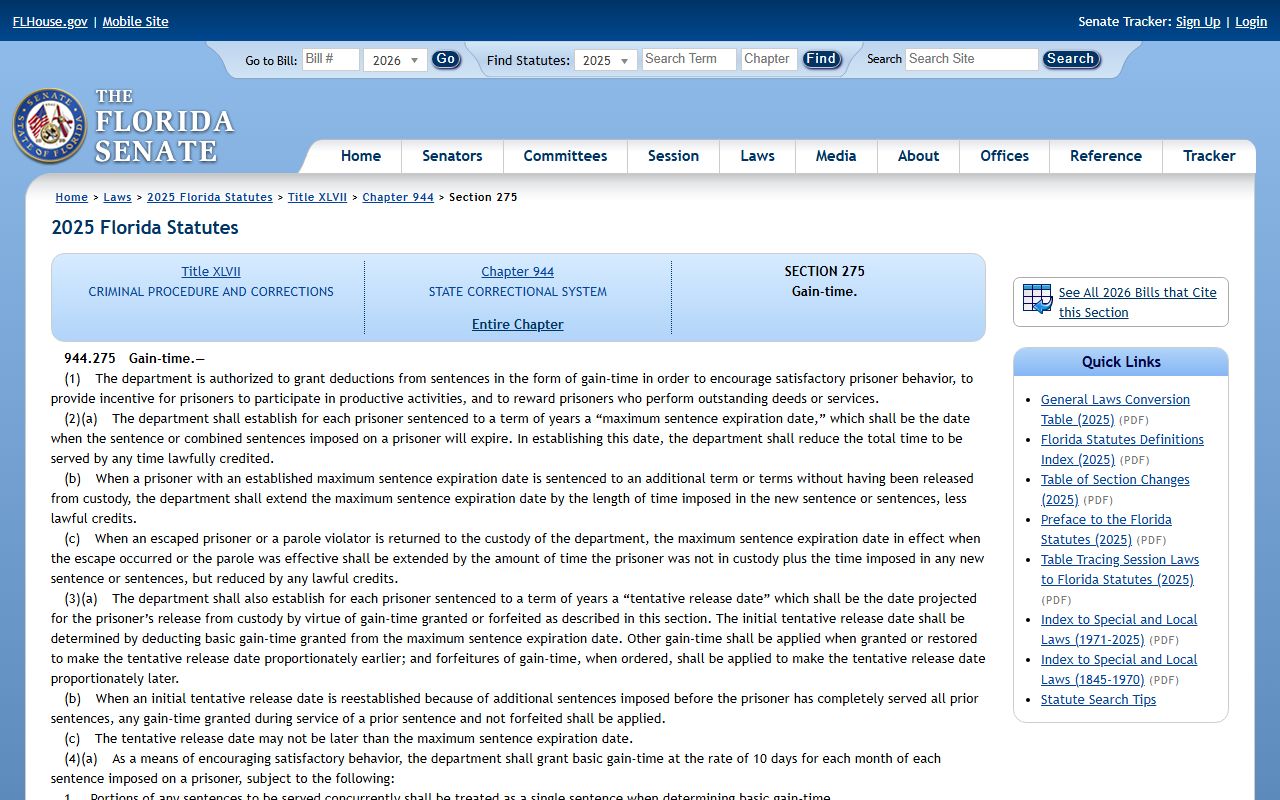
The statute screenshot connects FDC custody length, release calculations, and the 85 percent rule to a statewide legal source.
Florida Statutes section 944.275 governs gain-time and tentative release dates. For offenses committed on or after October 1, 1995, FDC may grant up to 10 days per month of incentive gain-time, but gain-time cannot result in release before the prisoner has served at least 85% of the imposed sentence. Parole is limited in Florida; OPPAGA explains that the Legislature abolished parole for most offenders in 1983 while keeping authority for a smaller eligible pre-abolition population.
Release records should be read by status. FDC reported 25,990 prison releases in FY 2024-2025, with most permanent releases caused by sentence expiration. The same report listed releases to conditional release supervision, probation, and community control. Conditional release under section 947.1405 and conditional medical release under section 947.149 are specific statutory processes, not general promises that a sentence will end early.
- DC Number
- The Department of Corrections identifier used to narrow an FDC inmate search when known.
- Gain-time
- Statutory credit that can affect a tentative release date but cannot bypass Florida's 85% service rule for covered sentences.
- Reception center
- An FDC facility mission used for intake, assessment, classification, or medical reception before longer-term placement.
- Community supervision
- FDC-supervised status outside prison, including records that may appear in a separate offender-network search.
FDC vs. County Jail: Where to Look
The FDC inmate population is the state-prison and state-supervision side of custody. County jails handle recent bookings, many pretrial detainees, local sentences, and local holds. If someone was booked this morning, start with the County Directory. If someone has been sentenced to Florida prison or has a DC number, use FDC.
| Question | First Florida Source | Why |
|---|---|---|
| Booked today or awaiting first appearance | County jail roster | FDC does not cover ordinary county jail custody. |
| Sentenced to state prison | FDC inmate population search | FDC is the state-prison system of record. |
| Released from prison or under state supervision | FDC release or supervised population search | Those records sit in separate FDC offender-network views. |
| Federal sentence or federal detention | BOP Inmate Locator | BOP custody is outside the Florida Department of Corrections. |
FDC Records Requests
For Florida Department of Corrections records, use the FDC Public Records Center. The portal provides request submission, a request center, request-number search, FAQs, and archive access. FDC portal guidance tells requesters not to submit duplicate requests, to be specific, and to reply to request emails to correspond with the assigned consultant.
The FDC Public Records Center is the official portal for submitting and tracking Florida Department of Corrections public-records requests.
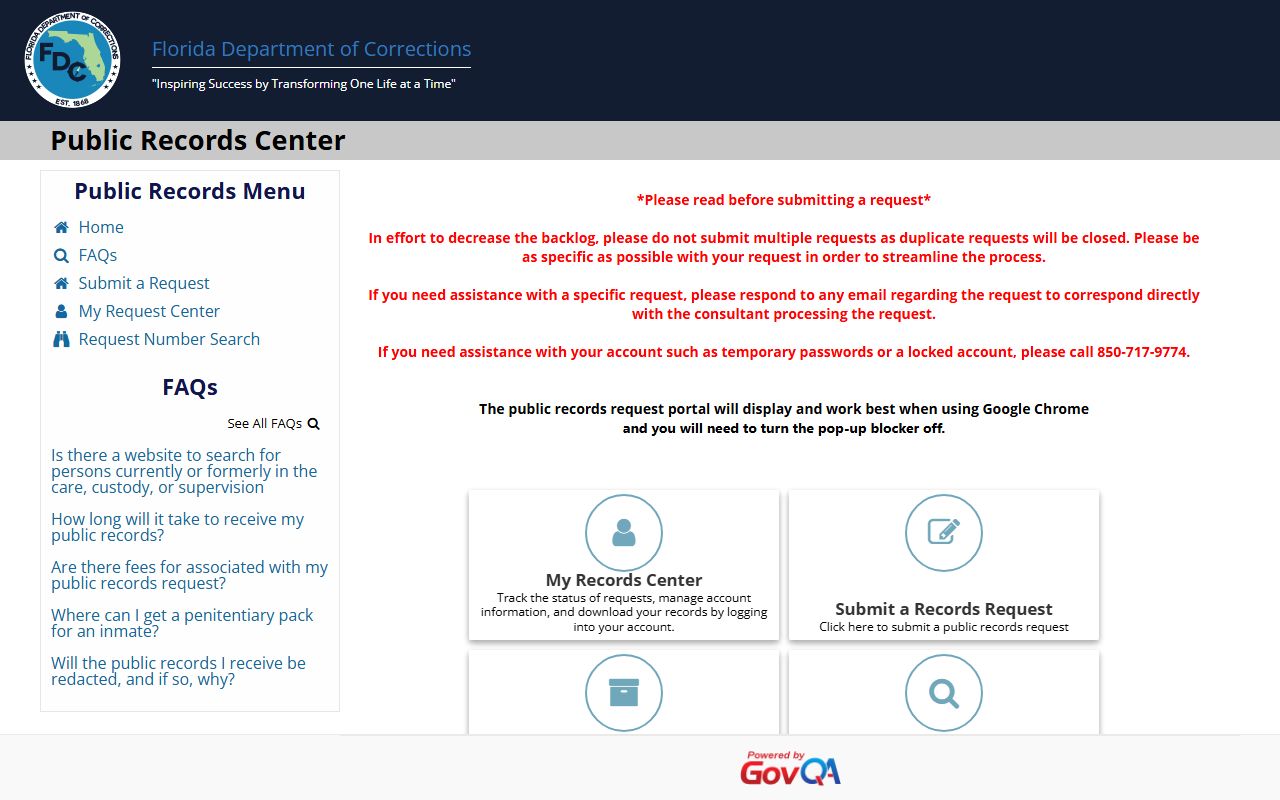
The records-portal screenshot supports the page's distinction between searching public offender data and formally requesting FDC records.
For county jail records, request from the local sheriff, county corrections department, or county public-records custodian. For court records after arrest, request from the clerk of court in the county where the case was filed.
- Identify the person by full name, date of birth if known, DC number, booking number, or case number.
- Name the record type, such as sentence computation, release record, incident report, disciplinary record, video, audio, or classification record.
- Give a date range and ask for electronic copies where possible.
- Expect redactions when Florida law protects health, security, victim, juvenile, sealed, or exempt material.