
The Florida Inmate Population
Florida has two major statewide inmate-population figures that should not be merged. The Florida Department of Corrections reported 89,087 inmates present in the Florida prison system on June 30, 2025. FDC separately estimated 54,432 inmates in county detention facilities during February 2026 through its Florida County Detention Facilities reporting. Both figures describe people in custody, but they answer different questions and come from different reporting systems.
The official Florida Department of Corrections homepage is the statewide starting point for the prison side of the Florida inmate population.
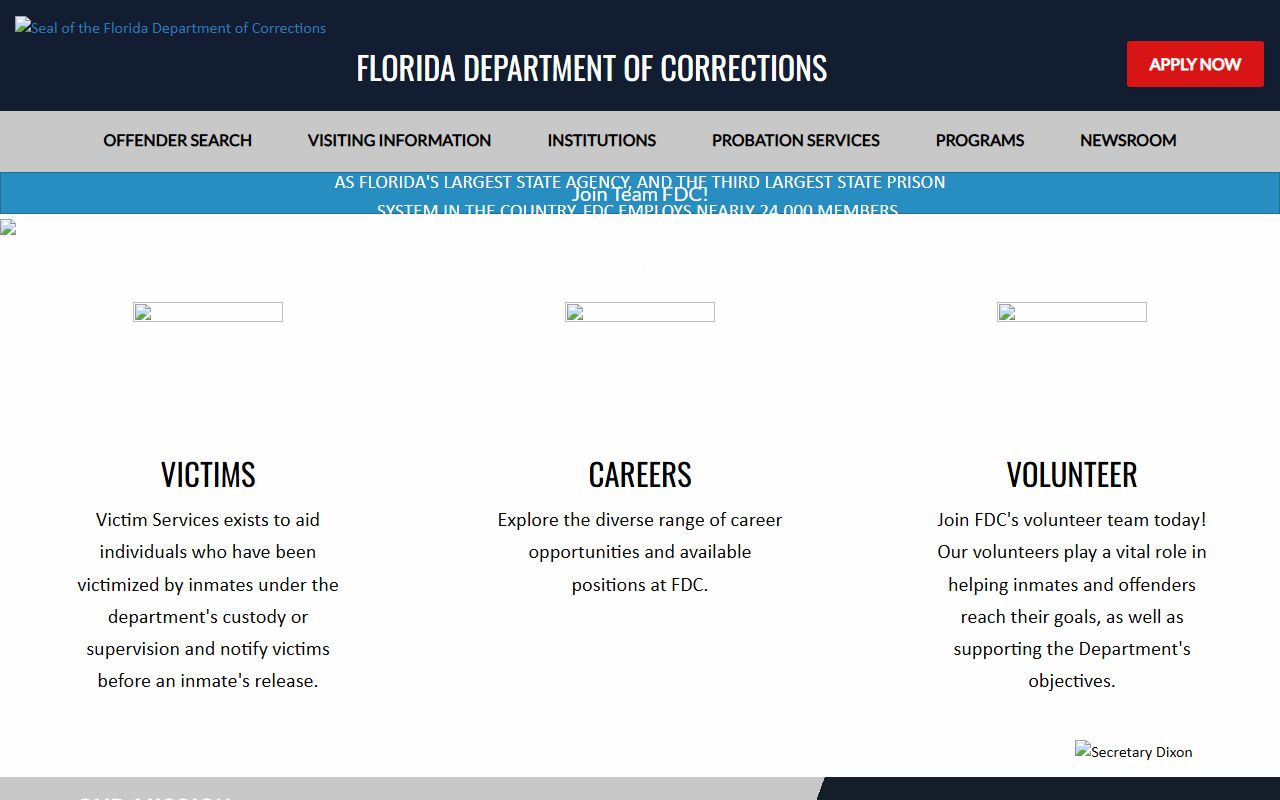
That screenshot anchors the distinction between FDC state-prison records and county jail records, which is the central split throughout this statewide site.
The state-prison number covers sentenced prisoners in FDC custody. The county detention number covers people held locally in Florida county and municipal detention facilities, including many people awaiting trial, awaiting transfer, serving shorter local sentences, or held for another agency. Florida has 67 counties, and the county layer is searched county by county rather than through one combined public jail roster.
This split is the reason a Florida inmate population search often starts with a routing decision. A person booked after a traffic stop, warrant arrest, violation hearing, or local criminal case may be in the county jail even if the case later produces a state sentence. A person already committed to FDC may have no active county roster profile. Federal and immigration custody add two more layers that do not depend on a Florida county jail roster.
Florida Inmate Population Statistics
The Florida inmate population keyword can mean a state-prison count, a county-jail count, or a search workflow. FDC's FY 2024-2025 Annual Report gives the dated state-prison count, while the February 2026 Florida County Detention Facilities report gives the dated county-detention estimate. The county report is population context, not a live public roster; it does not replace the local jail search in each county.
Florida's county detention reporting is tied to Florida Statutes section 951.23, the statewide source for county and municipal detention-facility standards and reporting.
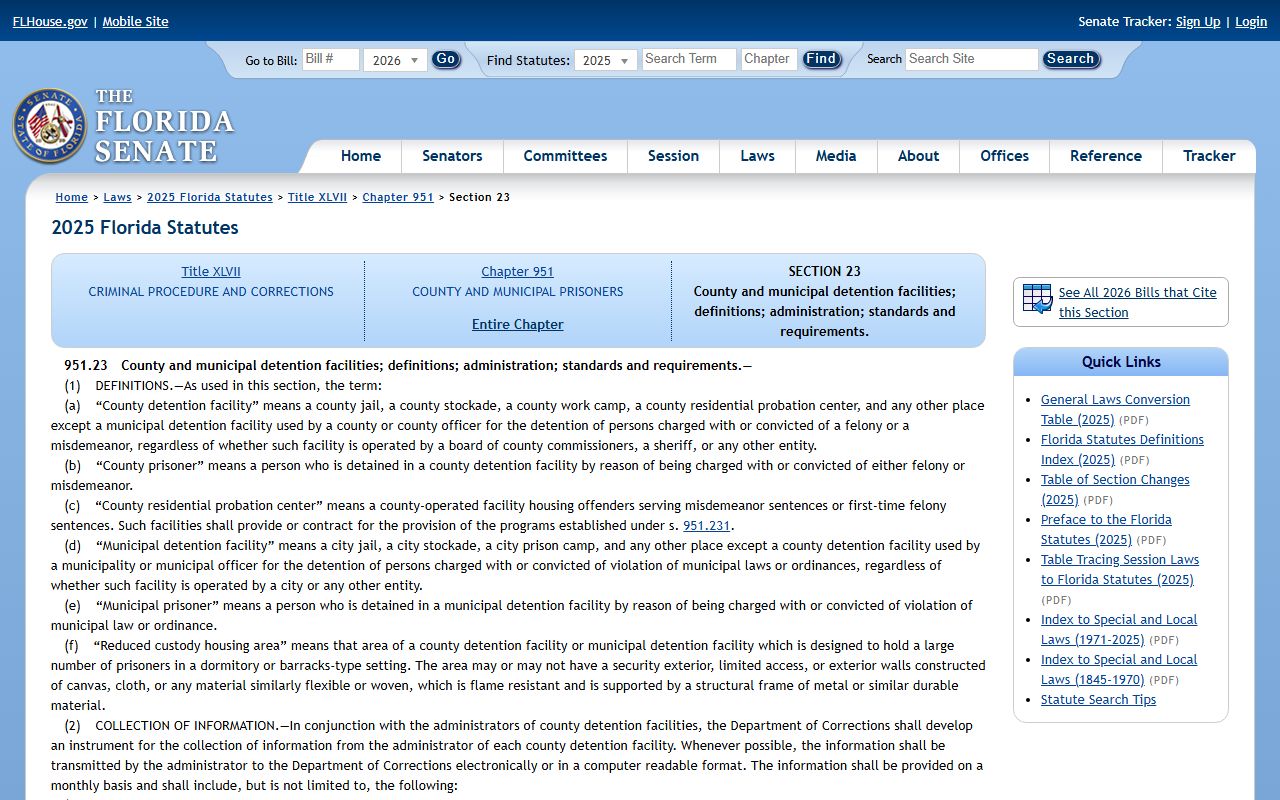
The statute screenshot supports why county jail population reporting is a statewide framework even though public jail rosters remain county-by-county searches.
| Measure | Figure | Source / Date |
|---|---|---|
| State prison population | 89,087 | FDC Annual Report FY 2024-2025, June 30, 2025 |
| County detention population estimate | 54,432 | FDC Florida County Detention Facilities report, February 2026 |
| Counties covered | 67 | Florida Department of State county list and local folder inventory |
| Statewide prison incarceration rate | 381.4 per 100,000 Floridians | FDC Annual Report FY 2024-2025 |
Those numbers also show why state-scope language has to stay precise. A statewide prison population table can show long-term prison trends, admissions, releases, and demographics. A county detention report can show local jail population by month. A roster search is different again because it is a person-level lookup that may show booking date, charge text, bond, housing, photo status, or release status when the county publishes those fields.
The FDC annual report adds more context for the prison side of the Florida inmate population. In FY 2024-2025, FDC reported 27,171 inmate admissions and 25,990 prison releases. Most permanent releases were sentence-expiration releases, while other releases moved to conditional release supervision, probation, or community control. Those admission and release figures help explain why a single custody search can change over time. A person can move from county booking to court sentencing, then to FDC reception, then to a prison, work camp, release center, supervision, or final release record.
Florida Inmate Population Trends
FDC's annual-report series shows a long decline from 99,119 state prisoners in 2016 to 80,495 in 2021, followed by four consecutive year-end increases through 89,087 in 2025. The 2025 figure was 1,784 inmates, or 2.0%, above the prior fiscal year.
Release timing and gain-time context for the prison population is governed through Florida Statutes section 944.275.
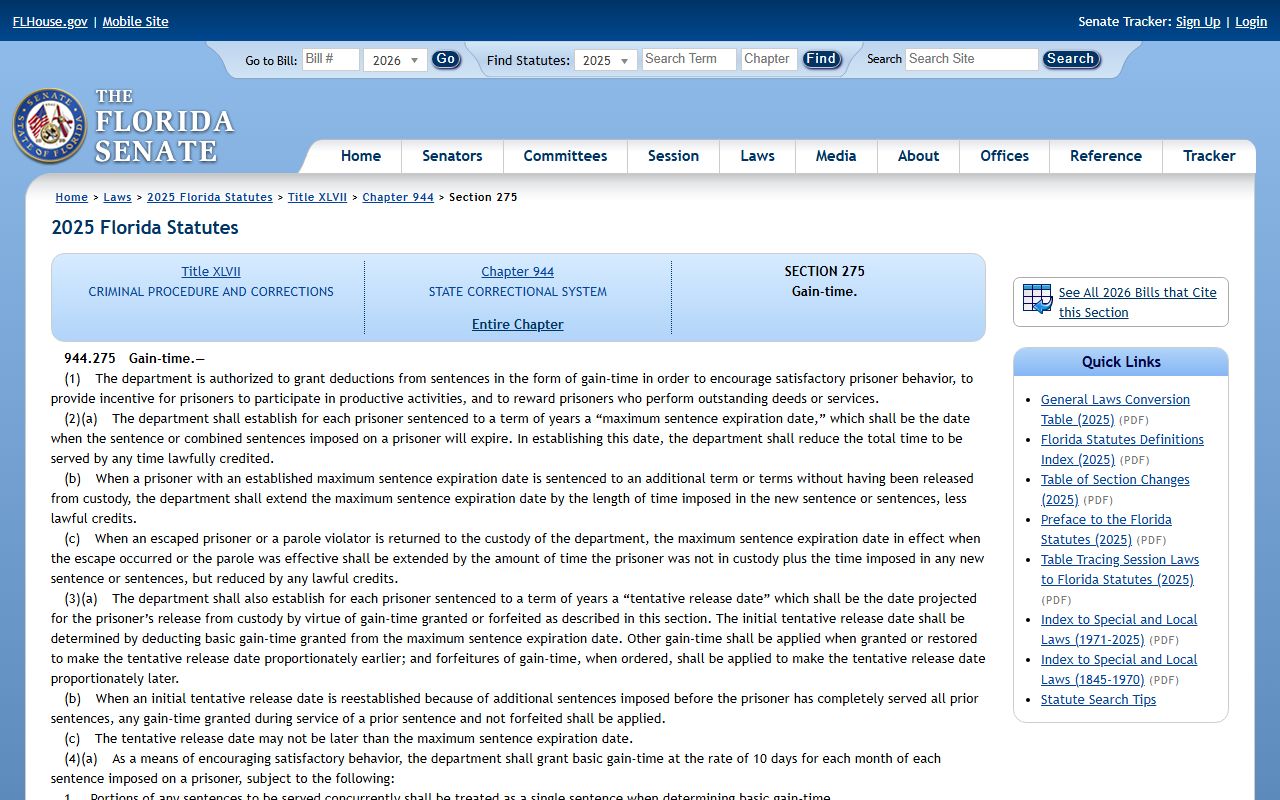
This statute image ties the population trend back to the release framework that affects how long sentenced prisoners remain in FDC custody.
| Year | FDC State Prison Population | Trend Note |
|---|---|---|
| 2016 | 99,119 | High point in the ten-year annual-report series cited in research |
| 2021 | 80,495 | Pandemic-era low point in the annual-report series |
| 2024 | 87,303 | Prior fiscal year before the 2025 increase |
| 2025 | 89,087 | June 30, 2025 FDC prison population |
Who Makes Up the Florida Inmate Population
FDC's June 30, 2025 demographic profile counted 82,826 male prisoners and 6,261 female prisoners in the state prison system. By age, the largest group was ages 35-49, with 36,611 prisoners, followed by ages 25-34, with 20,705 prisoners. FDC also reported that 45,490 prisoners had no prior FDC prison commitment. The same report groups prisoners by offense type, including murder or manslaughter, sexual offenses, robbery, violent personal offenses, burglary, theft, fraud, drug offenses, weapons, and other offenses.
- County jail vs. state prison: County jails and FDC prisons are different systems with different public searches.
- Recent arrest vs. sentence: A recent booking usually appears in a county roster before any FDC record exists.
- State supervision: FDC also maintains supervised population and absconder/fugitive searches.
- Federal and ICE custody: BOP and ICE searches are separate from both FDC and county jail rosters.
County jail population has a different mix because the local jail can hold people before trial, people waiting for transport, people serving shorter local sentences, and people held under local, state, federal, or immigration-related authority. That is why a Florida inmate population search should avoid assuming that a blank FDC result means no custody exists. The person may still be in a county roster, a clerk case, BOP custody, ICE custody, or a VINE notification record.
Laws Governing Florida Inmate Records
Florida's public-records framework is broad, but not every jail, prison, or court record is open in the same way. Chapter 119 governs inspection and copying of nonexempt public records. Section 951.23 governs county and municipal detention-facility standards and monthly population reporting. FDC records requests go through the FDC Public Records Center, while county jail records go to the sheriff, county corrections department, or local records custodian.
Key Florida sources:
Florida Statutes section 119.07 - requires inspection and copying of nonexempt public records at reasonable times and under reasonable conditions.
Florida Statutes section 951.23 - governs county and municipal detention-facility standards and FDC population reporting.
Florida Statutes section 944.275 - governs gain-time, tentative release dates, and the 85% rule for many Florida prison sentences.
For formal Florida Department of Corrections records, the FDC Public Records Center is the official request portal.
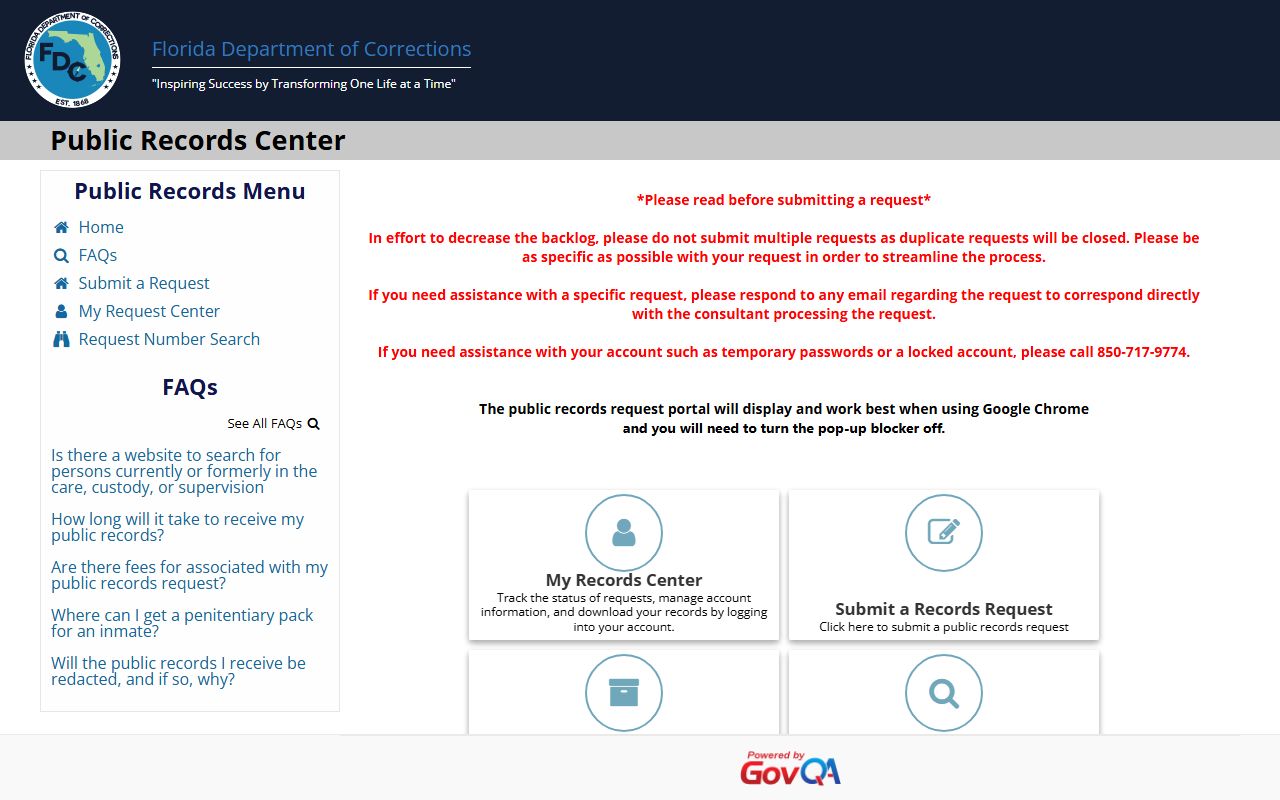
The records-center screenshot separates a quick offender search from a formal public-records request for sentence, classification, release, incident, or other FDC material.
How to Search the Florida Inmate Population
A reliable Florida inmate search starts by deciding which custody system is likely to hold the person. FDC is correct for sentenced Florida state prisoners and state-supervision records. The county jail roster is correct for most recent arrests and local jail custody. BOP, ICE, and VINELink cover other search needs.
The primary state-prison lookup is the FDC Inmate Population Information Search.
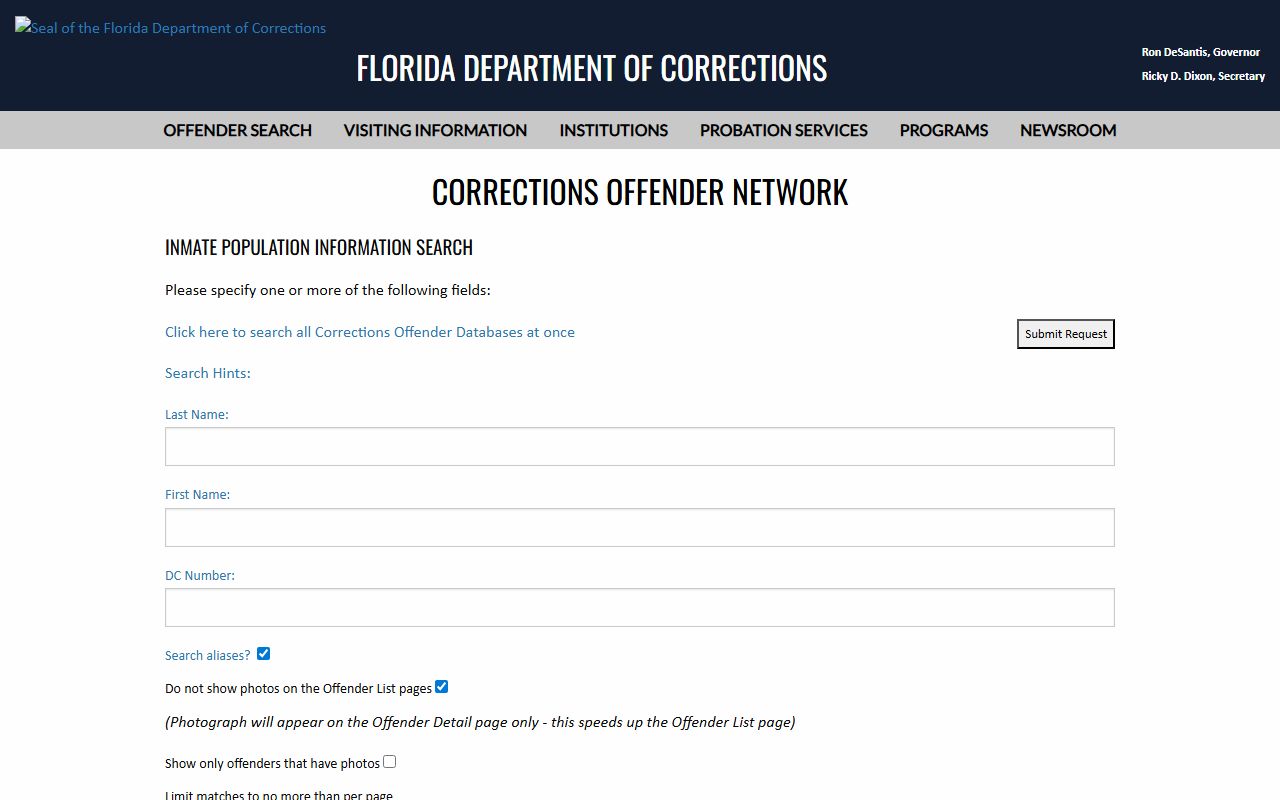
The form screenshot shows why the statewide search path starts with the custody system and then narrows by name, DC number, aliases, and other FDC search options.
- For a sentenced state prisoner or state supervision record, use the FDC Inmate Population Information Search.
- For a recent arrest or pretrial hold, choose the county in the Florida County Directory.
- For a known building, use the Florida Detention Facility Directory.
- For federal custody, use the BOP Inmate Locator.
- For immigration detention, use ICE ODLS; for notifications, use Florida VINELink.
When a person may be in federal custody, the Federal Bureau of Prisons Inmate Locator is the relevant national search system.
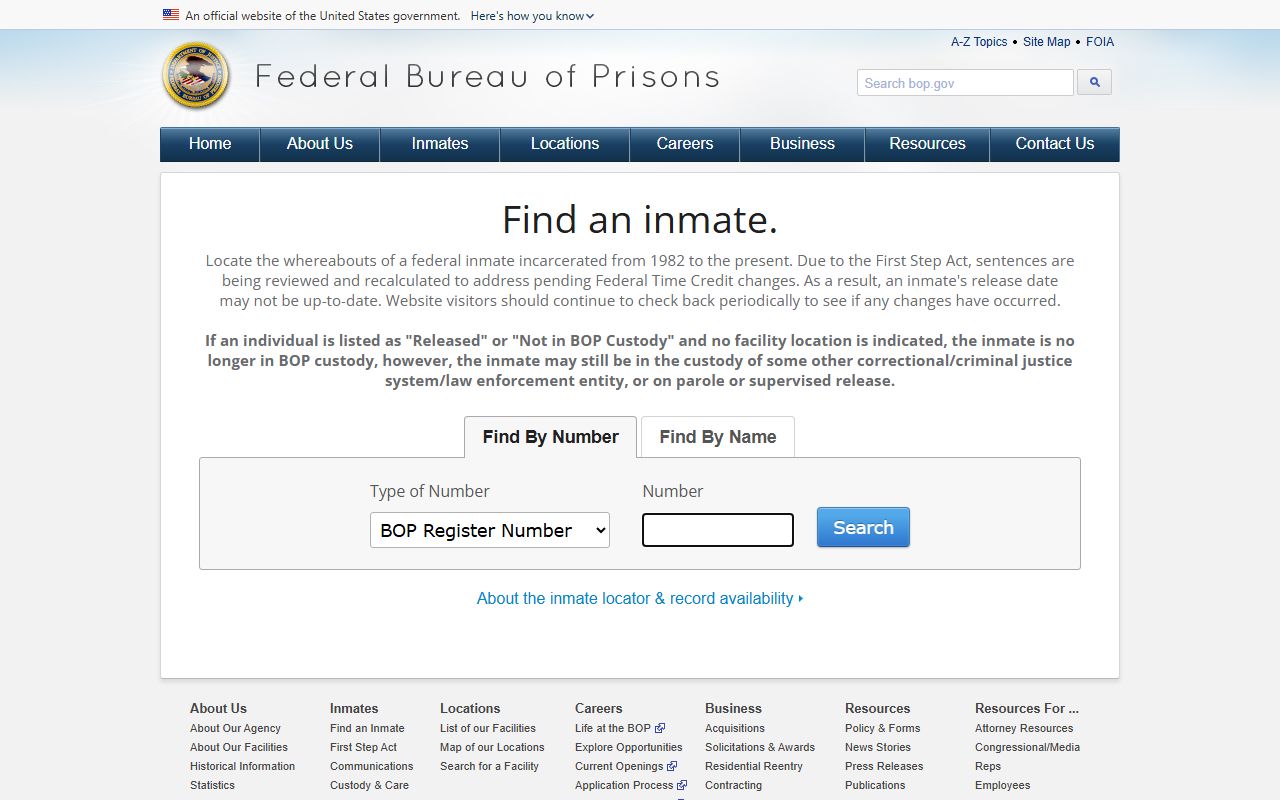
The BOP screenshot reinforces that federal custody is a separate search lane from Florida county jails and FDC state prisons.
For custody and case notifications, Florida users can also use Florida VINELink.
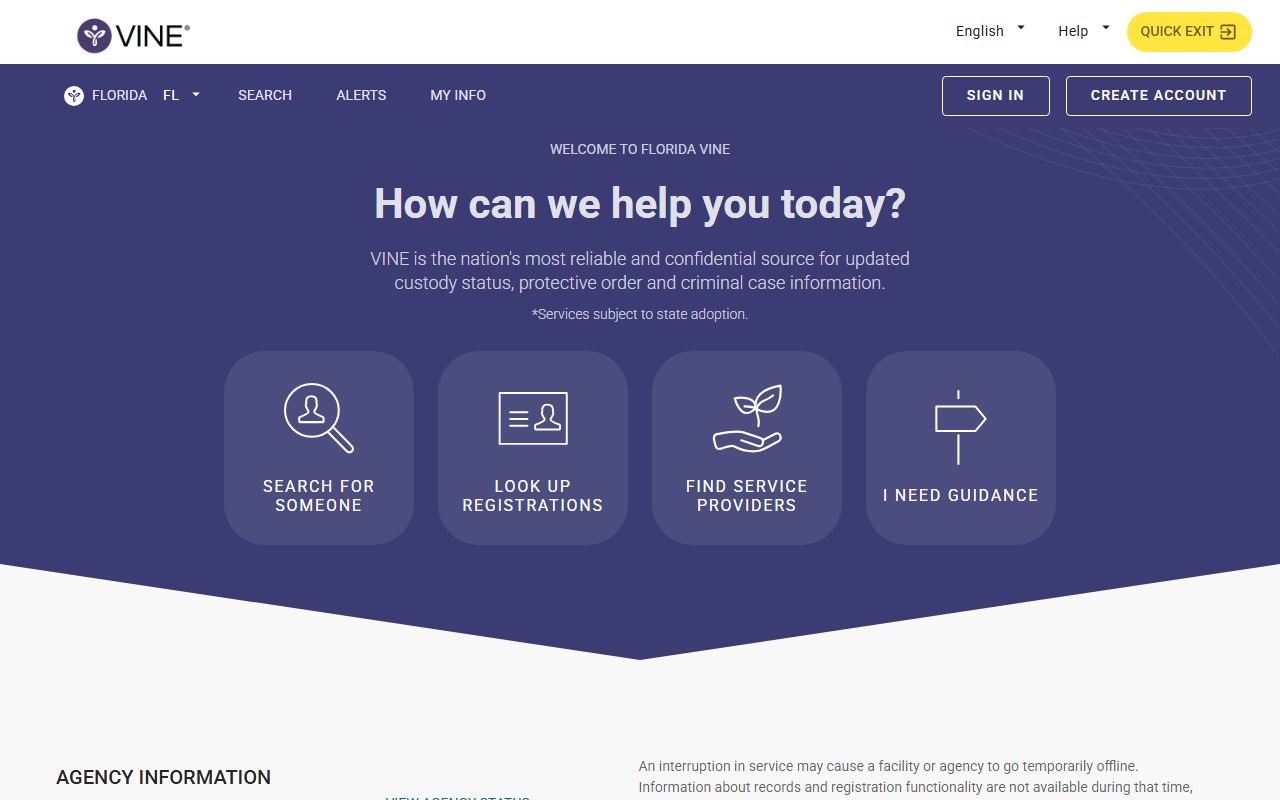
VINELink is useful for notification and custody-status monitoring, but it does not replace the full county roster, FDC profile, or court file.
County Jail vs. FDC State Prison
State prison is not county jail. A county jail roster may show an arrest, booking date, bond, current charges, and local custody status. An FDC record covers felony offenders sentenced to FDC or under state supervision and does not include county jail, county probation, or other local supervision records.
The FDC Corrections Offender Network menu shows the separate state databases for inmate population, release, escape, supervision, and absconders.
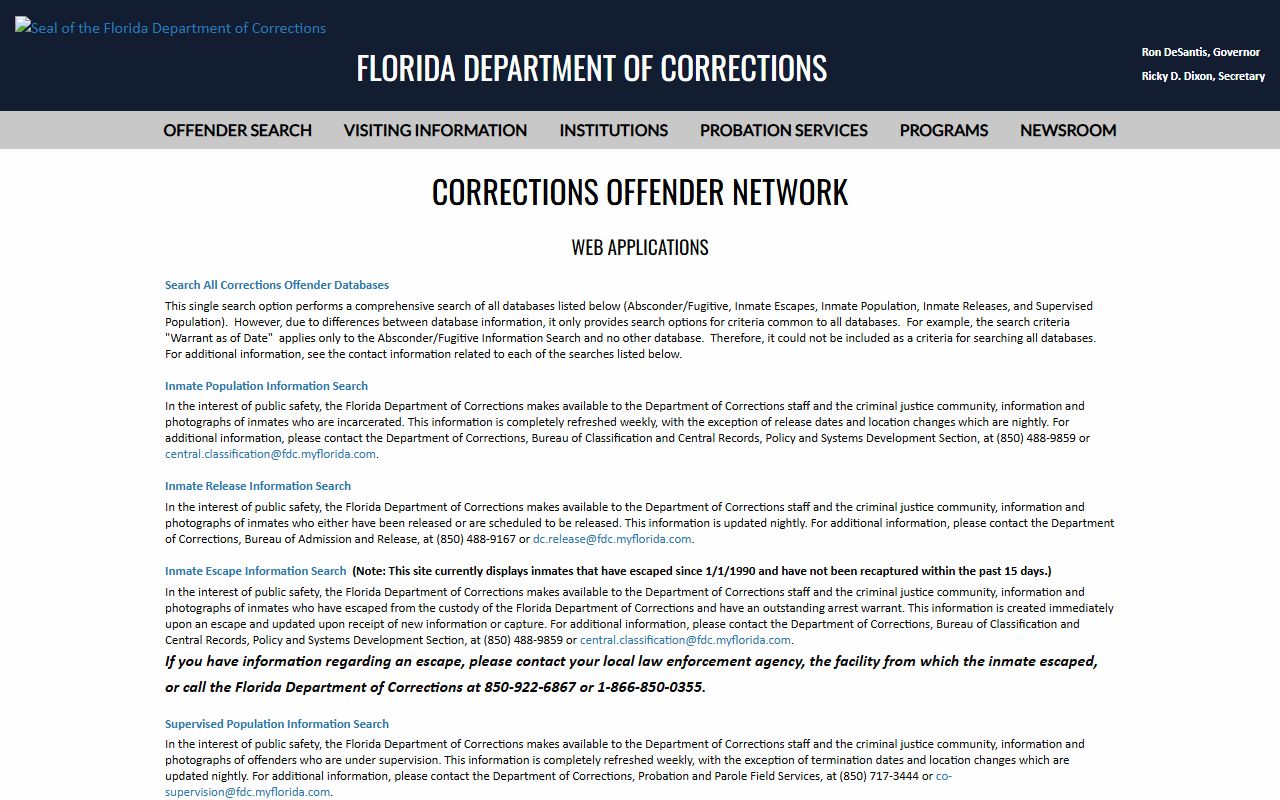
That menu is a visual reminder that even within FDC, different status questions may require different offender-search views.
| County Jail | FDC State Prison | |
|---|---|---|
| Who is held | Recent arrests, pretrial detainees, local sentences, and local holds | Felony offenders sentenced to Florida prison or state supervision |
| Run by | County sheriff or county corrections department | Florida Department of Corrections |
| Where to look | County roster through the county subdomain | FDC inmate locator and offender network |
| Update caution | Varies by county | FDC warns records can change quickly and may not show true current status |
Florida's custody map also includes community supervision, release records, and absconder data. The FDC offender network has separate views for those statuses. County jail rosters may stop showing a person after release or transfer, while the court file may still show pending charges, plea events, sentencing, or post-judgment activity. A complete Florida inmate population search often checks more than one system because each system is built for a different record custodian.
- County jail
- A local detention facility for recent arrests, pretrial custody, local sentences, and holds.
- FDC
- The Florida Department of Corrections, which handles sentenced state prisoners and state supervision records.
- Detainer
- A request or hold from another agency that can affect release even when a local charge has bond.
- Conditional release
- A Florida post-prison supervision process for eligible offenders under statutory review and conditions.
Florida Inmate Population FAQ
How big is the Florida inmate population?
FDC reported 89,087 inmates present in the Florida prison system on June 30, 2025. Separately, FDC's February 2026 county detention report estimated 54,432 inmates in county detention facilities. Those are different counts from different systems.
How do I find which county jail holds someone?
Start with the county where the arrest happened, where the court case was filed, or where the person was last known to be held. The County Directory links to all 67 county subdomain roots using the APEX_DOMAIN_TBD placeholder.
When should I use FDC instead of a county roster?
Use FDC when the person is a sentenced Florida state prisoner, has a DC number, appears to be under state supervision, or may be in an FDC release, escape, supervised population, or absconder/fugitive database.
Where do Florida trial-court records fit?
Most trial-court criminal records after a jail arrest are still searched through the county clerk where the case was filed. Florida's statewide court resources help with appellate search, filing infrastructure, and secured case-information concepts, but they do not replace every county clerk public search.
The Florida Courts E-Filing Authority page gives statewide filing and clerk-governance context for court records after arrest.
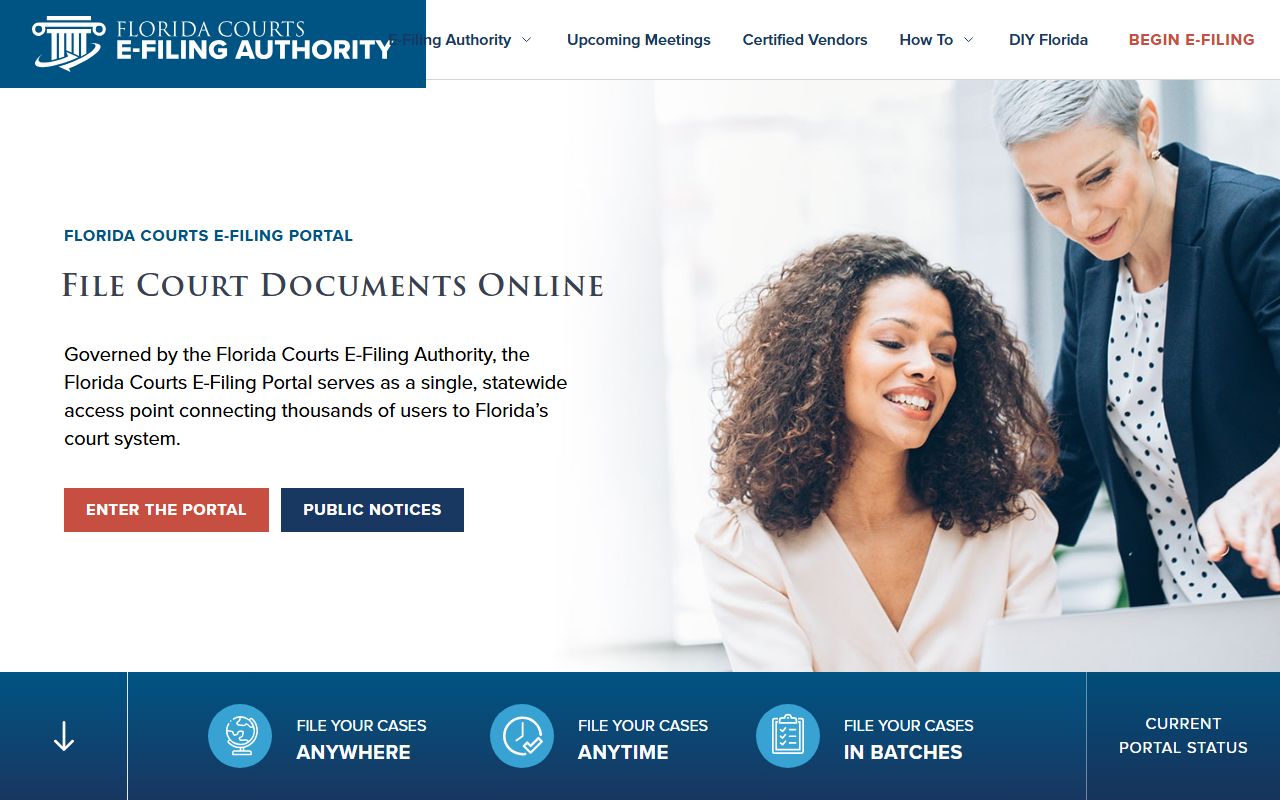
The e-filing screenshot adds the court-record layer to the homepage without suggesting that filing infrastructure is the same as a public county criminal search.
For statewide court routing after an arrest, the Florida Appellate Case Information System case search is one of the statewide court portals, while trial-court criminal records still usually route to county clerks.
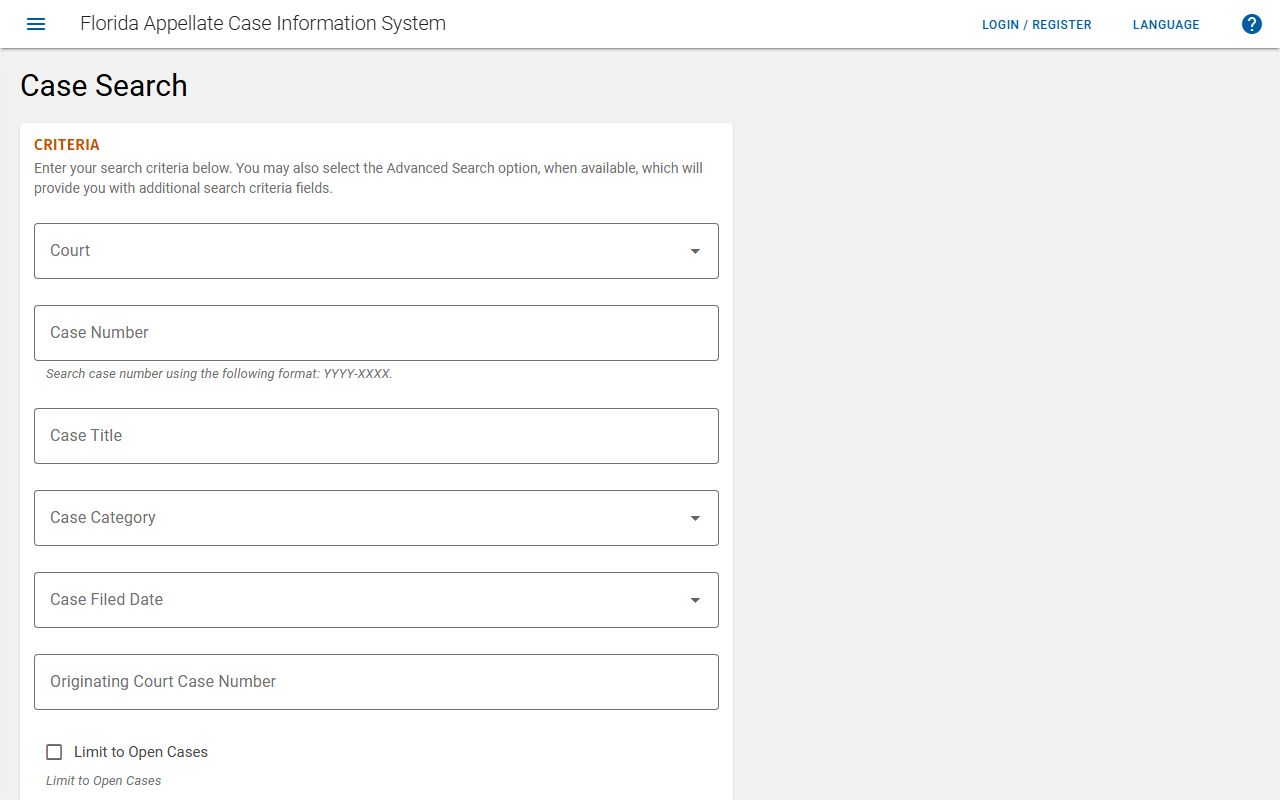
The appellate screenshot supports the homepage's broader routing point: jail, prison, federal, notification, and court systems each answer different questions.
Can VINELink replace the roster?
No. Florida VINELink is useful for custody and case notifications, including release, transfer, escape, death, or case-status alerts where available. It is not the same as a county jail booking profile, an FDC sentence profile, a BOP record, an ICE detainee search, or a clerk docket.
What if no Florida search has a match?
A blank result does not prove the person is free. The name may be misspelled, the booking may not be posted yet, the person may have been released, the record may be restricted, or the person may be in another custody layer. Try the county roster, FDC, BOP, ICE, VINELink, and the clerk record that fits the facts known.