
Florida Inmate Record Systems
Florida does not operate one public jail roster for every person in custody. County sheriffs and county corrections departments control local jail records for fresh arrests, pretrial detention, local sentences, and local holds. The Florida Department of Corrections, abbreviated FDC, controls the separate state-prison and state-supervision records for felony offenders sentenced to the Department of Corrections. Federal BOP records and ICE detention records sit outside both of those systems.
The basic search rule is simple. Start local when the arrest is recent. Move to FDC when the person has a Florida prison sentence, a DC number, a state supervision record, a state release record, an escape record, or an absconder entry. Search BOP for federal custody, and use ICE's locator when immigration detention is the issue. Florida VINELink can support custody and case notification, but it is not a full jail booking archive.
The FDC Corrections Offender Network menu shows the separate state offender databases for inmate population, release, escape, supervised population, and absconders.
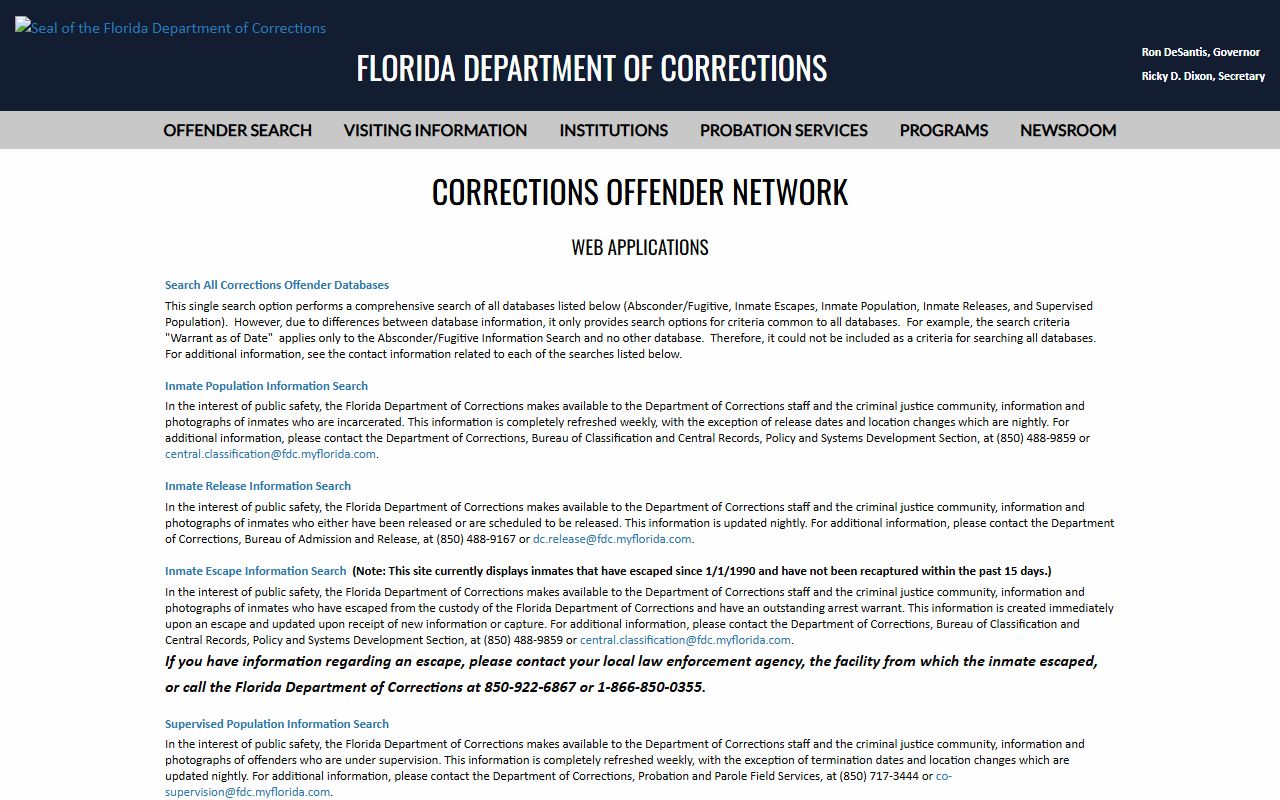
That menu is useful because a Florida inmate record may sit in a prison, release, supervision, escape, or absconder database instead of a county jail roster.
Statewide scope: county jail records, FDC prison records, BOP records, ICE records, VINELink notices, and court records answer different custody questions.
Find Florida Jail Records
A recent jail booking normally appears first in the county where the person was booked or held. Florida has 67 counties, and the statewide research confirms that all 67 have sibling locality folders in this project. That complete county layer matters because county jail records do not move into one central public roster. A person booked in Miami-Dade, Duval, Hillsborough, Orange, Broward, or a smaller county should be routed through that county's jail or corrections page before a state or federal search is assumed.
County jail rosters vary by local agency. Many list active custody records, recent bookings, bond or hold information, booking dates, charges, and housing or status details. Some counties publish booking photos. Others limit online data or require a public-records request for older or suppressed material. Section 951.23, Florida Statutes, gives the statewide detention-facility framework, but it does not create one live statewide roster.
The Florida county and municipal detention facility statute is the source for statewide jail standards and reporting context.
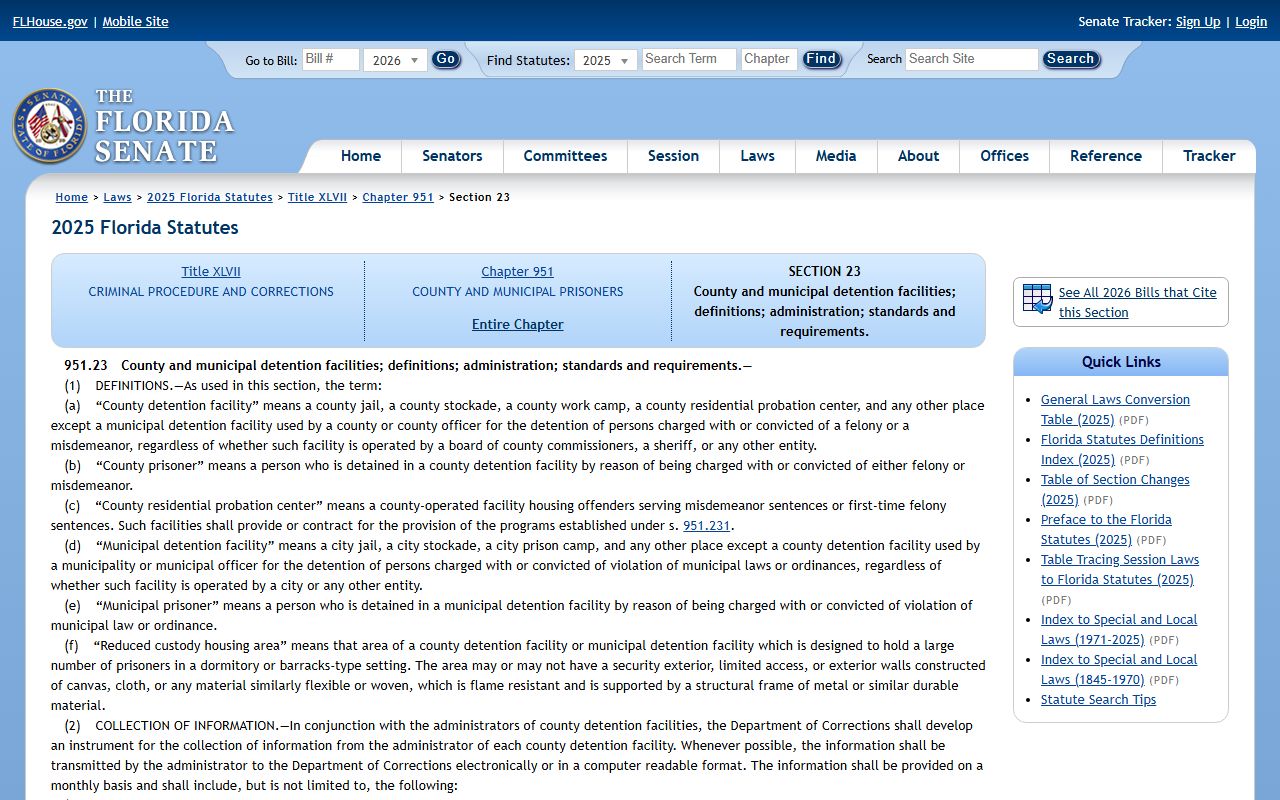
The statute screenshot supports the distinction between statewide jail reporting rules and the county-level roster pages that hold current booking detail.
- Identify the booking county or likely holding county from the arrest, court case, family notice, or law enforcement agency.
- Open the Florida County Directory and choose the matching county site.
- Search the local jail roster with the name, booking number, or other available identifier.
- Compare the roster result against age, sex, charge text, booking date, status, bond, or housing information before relying on a match.
- If the county roster is blank, check FDC, BOP, ICE, VINELink, and the county clerk rather than assuming release.
Note: a roster gap can mean transfer, release, spelling mismatch, sealed data, juvenile status, or a separate custody system.
Florida State Prison Records
FDC is the source for sentenced Florida state prisoners and state-supervision records. The agency's own search language says the inmate population database contains public-record information on felony offenders sentenced to the Department of Corrections. It includes state prison and state supervision records, plus current and prior offenses, but it does not include county jail, county probation, or other local supervision records. That limit is the most common search mistake in Florida inmate records work.
The main FDC Inmate Population Information Search is the statewide locator for incarcerated Florida state prisoners.
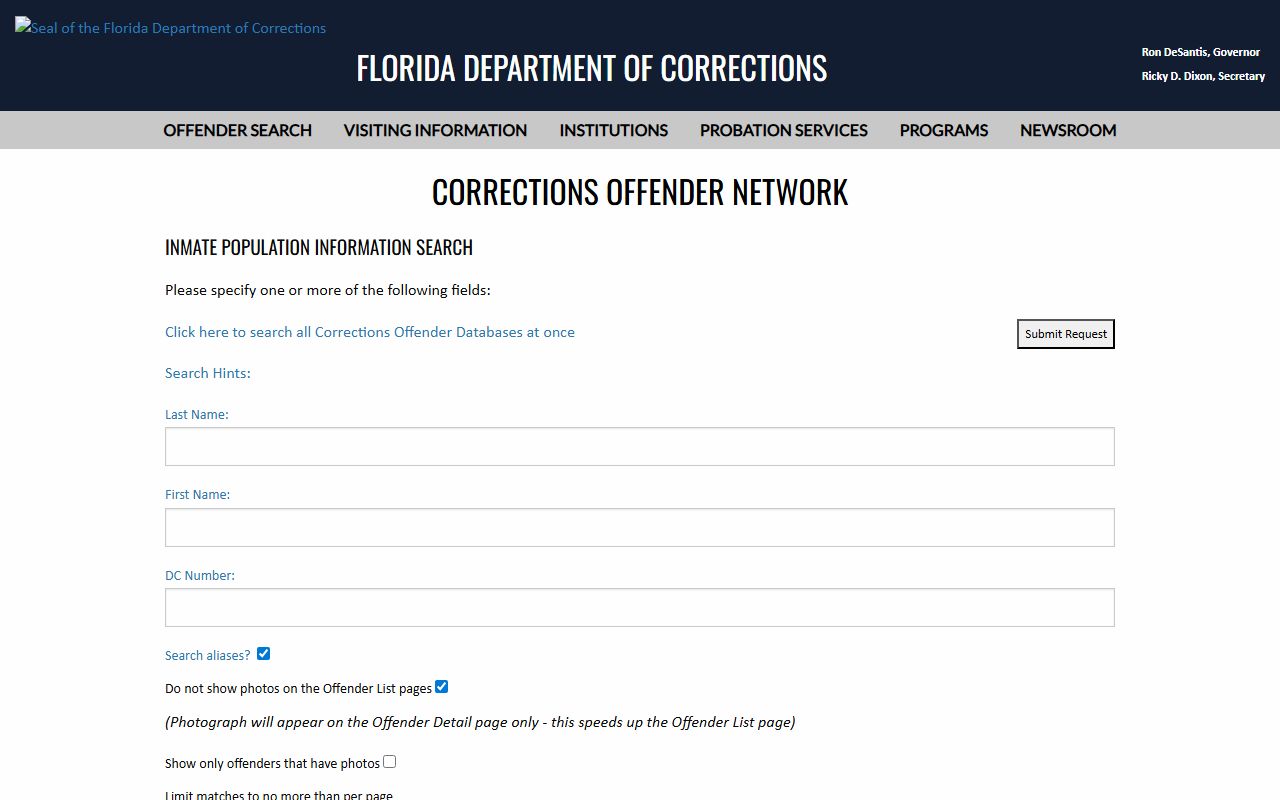
The form shows why FDC works best when a DC number, full name, probable alias, or photo filter can narrow the search.
| Search field | Use | Research note |
|---|---|---|
| Last name | Name lookup | FDC searches names that begin with the typed letters. |
| First name | Name lookup | Useful with last name, but partial names can return broad results. |
| DC number | Identifier lookup | The scoresheet manual describes the DC number as the six-digit Department number when available. |
| Alias option | Expanded name search | Helpful when a person used another name or spelling. |
| Photo options | Result filter | FDC offers options to show, hide, or require photos in results. |
| Match limit | Result control | FDC provides page limits from small to larger result sets. |
FDC warns that information can change quickly and may not show the true current location, status, release date, or other offender information. The research also notes that inmate population information is refreshed weekly, except release dates and location changes, which update nightly according to FDC search-page language captured in the statewide materials. For questions about inmate population information, FDC directs users to the Bureau of Classification and Central Records at 850-488-9859.
Florida Inmate Profile Fields
Florida inmate records do not use one uniform field set. A county jail booking profile is built for intake and local custody. An FDC profile is built for prison sentence, custody classification, supervision, release, or other state correctional status. BOP and ICE records use federal identifiers and federal custody terms. The safest reading is to treat each field as agency-specific and to verify against at least two identifiers before acting on a result.
| Field | What it usually shows | Where it is most common |
|---|---|---|
| Name and aliases | Legal name, alternate names, or spelling variants used by the agency. | County jail, FDC, BOP, ICE |
| Booking or agency number | Local booking number, jail number, DC number, register number, or A-number. | All systems, with different labels |
| Booking or admission date | Jail intake date, prison admission date, or custody entry date. | County jail, FDC, BOP, ICE |
| Charges or offenses | Booking charges, court-filed charges, conviction offenses, sentence data, or federal custody basis. | County jail, courts, FDC, BOP |
| Bond, hold, or sentence | Local bond, detainer, release status, tentative release, or sentence information. | County jail, FDC, courts |
| Facility or location | Current jail, prison, federal facility, immigration facility, or displayed custody status. | County jail, FDC, BOP, ICE |
| Booking photo | A county intake photo or agency profile image when published. | County jail, some FDC records |
The field names may look similar, but the record purpose is different. A county "charge" may be a booking label before the prosecutor files formal charges. An FDC offense reflects the state corrections side after sentencing or supervision entry. A court record may later show a dismissal, plea, conviction, sentence, seal, or expungement that the jail roster does not fully explain. For court follow-up after a booking, use Florida court records after a jail arrest.
- Detainer
- A hold or notice from another agency that can affect release from the current jail.
- DC number
- The Department of Corrections identifier used in FDC records when assigned.
- Pretrial
- Custody before the criminal case has reached final judgment or sentencing.
- State supervision
- FDC community supervision such as probation-style supervision or other post-prison supervision categories.
Florida Custody Search Channels
Florida records work is partly a routing exercise. FDC reported 89,087 inmates present in the Florida prison system on June 30, 2025, while its February 2026 county detention facilities report estimated 54,432 inmates in county detention facilities for that month. Those two statewide figures should not be merged. They come from different reporting systems and describe different populations.
| Need | Best starting point | Important limit |
|---|---|---|
| Fresh arrest or local jail custody | County jail roster through the county directory | No single statewide live jail roster replaces county searches. |
| Florida prison sentence | FDC inmate population search | FDC does not include county jail or county probation records. |
| Federal prison or detention | BOP Inmate Locator | BOP does not search Florida county jails or FDC state prisons. |
| Immigration detention | ICE Online Detainee Locator System | ICE custody cannot be inferred from a county booking alone. |
| Custody or case alerts | Florida VINELink | VINELink is for status and notification, not the full booking file. |
The Federal Bureau of Prisons Inmate Locator applies to federal inmates incarcerated from 1982 to the present.
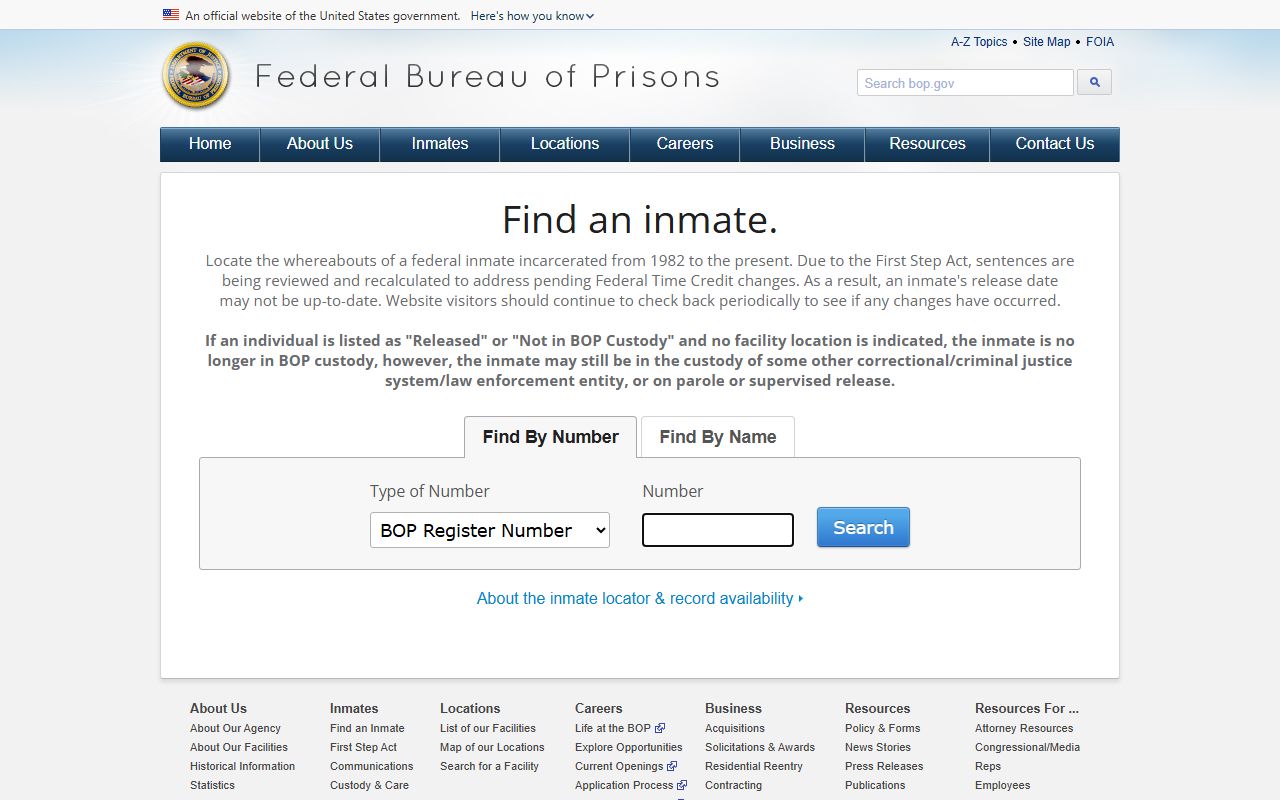
The BOP screenshot keeps federal custody separate from Florida county jail records and FDC state-prison records.
VINELink has a different role. Florida VINE is described in the statewide research as a free, secure, confidential way to access custody status and criminal case information, find state-approved service providers, and register for notifications. Local Florida VINE pages also note web registration and phone registration through 1-877-846-3435. It helps with release, transfer, escape, death, custody-status, or case alerts, but a full booking record still comes from the county jail or public-records custodian.
The Florida VINELink page is the statewide notification access point identified in the research.
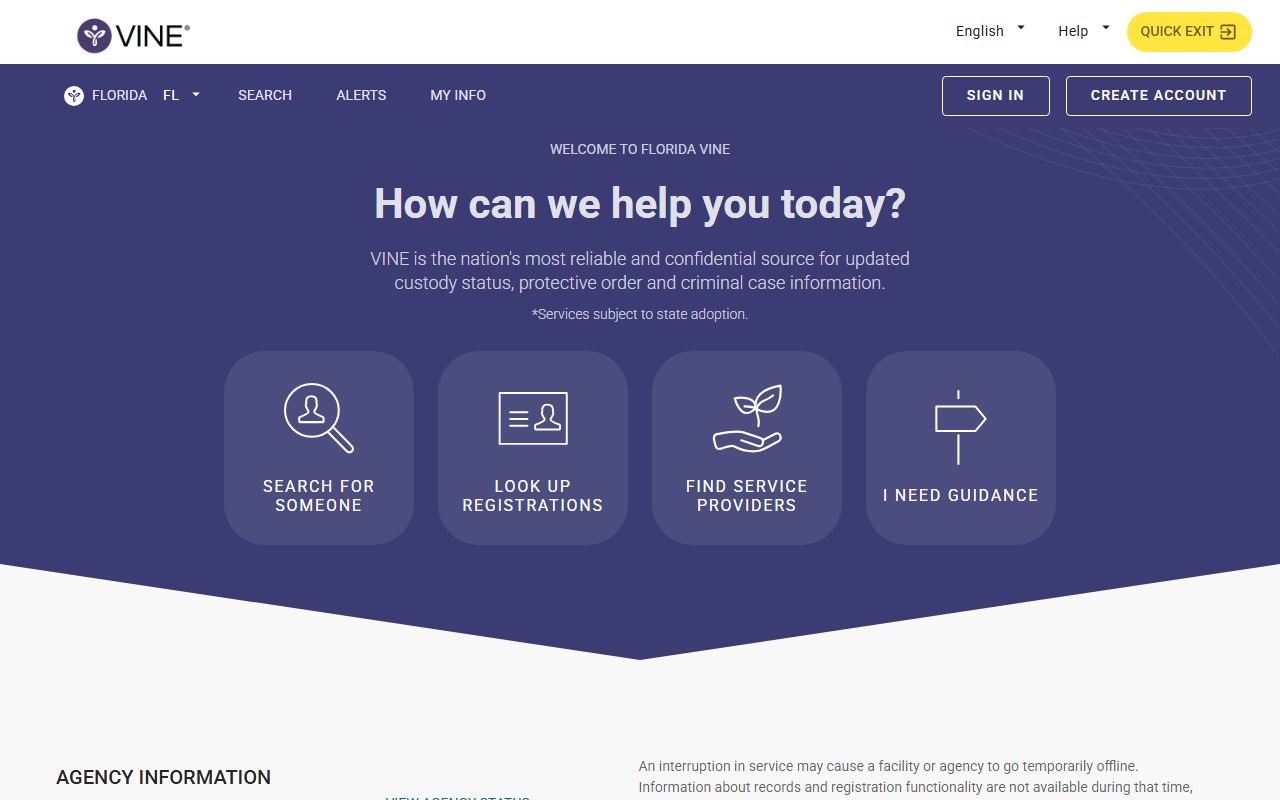
The VINELink screenshot ties custody-status alerts back to the broader search chain without replacing the roster, FDC, BOP, ICE, or court systems.
Request Florida Inmate Records
Florida's public-records law is Chapter 119, Florida Statutes. Section 119.07 requires custodians to permit inspection and copying of nonexempt public records at reasonable times, under reasonable conditions, and under supervision by the custodian or designee. The law is broad, but exemptions still matter. Sealed and expunged records, juvenile information, victim information, active investigative material, confidential health or security information, certain images, protected addresses, and other statutory categories may be withheld or redacted.
For state corrections records, the official route is the FDC Public Records Center.
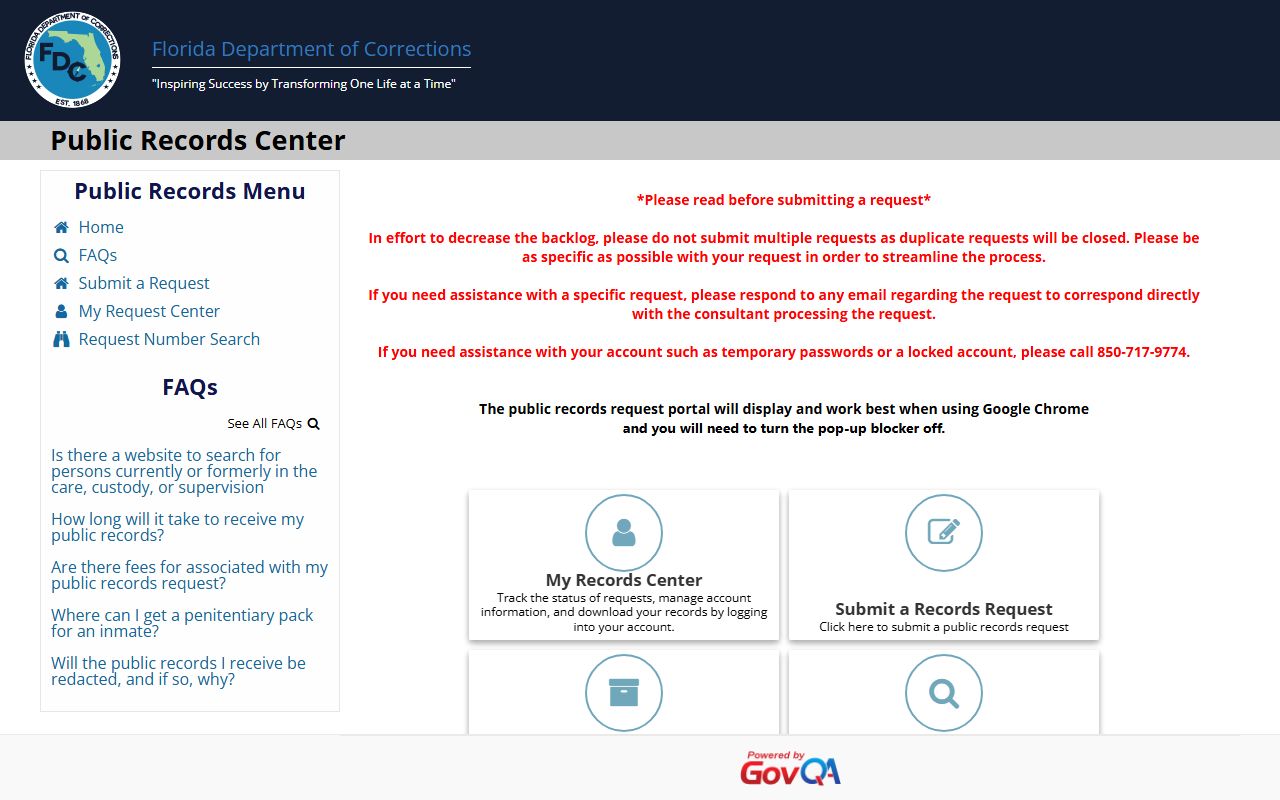
The portal screenshot supports the distinction between a quick lookup and a formal request for state corrections material.
For county jail records, send the request to the sheriff, county corrections department, or public-records custodian for the county that holds the record. For court records after arrest, contact the clerk of court where the criminal case was filed. For federal prison records, use BOP or federal FOIA channels. For ICE records, use ICE, DHS, or the facility channel that matches the custody issue.
- Identify the person by full name and add date of birth, booking number, DC number, case number, or another known identifier.
- Name the agency likely to hold the record, such as county jail, FDC, BOP, ICE, clerk, state attorney, or arresting agency.
- State the date range and record type, such as booking record, jail log, mugshot, incident report, sentence computation, release record, video, or phone recording.
- Ask for electronic copies where possible to reduce cost and speed delivery.
- If material is withheld, ask the custodian to identify the exemption relied on for the redaction or denial.
Note: public-records requests are for records held by the agency, not for legal advice, custody verification, or emergency release help.
Florida Facility Rules Vary
After the correct inmate record is found, the next practical step is usually facility-specific. Visitation schedules, mail formats, video-visit systems, phone rules, commissary deposits, and release procedures are set by the jail, prison, federal facility, or immigration facility holding the person. The statewide research shows Florida has county jails, FDC institutions, annexes, work camps, reception centers, re-entry centers, community release centers, federal facilities, ICE detention facilities, juvenile detention programs, and a small number of municipal temporary holding rows in the facility roll-up.
The safest route is to confirm the current facility before visiting, sending money, mailing a letter, or relying on posted release details. Large counties may operate more than one jail building. Broward, Miami-Dade, Orange, Polk, and Volusia all have multiple jail or corrections entries in the statewide facility roll-up. Some counties also contain FDC, federal, or ICE facilities that do not hold the same population as the county jail.
| Facility type | Records to check first | Common next step |
|---|---|---|
| County jail | County roster or jail records custodian | Confirm bond, status, visiting, mail, and release rules locally. |
| FDC prison or work camp | FDC offender search and FDC records channels | Check institution rules after confirming the current location. |
| Federal facility | BOP locator | Verify the BOP facility and use federal procedures. |
| ICE detention | ICE ODLS and facility routing | Confirm custody with ICE or the listed detention facility. |
| Juvenile or temporary holding | Agency-specific contact or court process | Do not assume adult public roster access applies. |
Verification rule: do not treat an old roster hit as proof of current custody, release eligibility, bond, or housing location.